
The best status symbol wheels for high-end vehicles combine distinctive design with precise fitment, quality construction, and durability. No single style defines luxury for every driver. The right choice complements your vehicle and suits how you use it.
It’s understandable to ask which luxury wheel company is the best in the world, but a name alone won’t tell you whether a wheel fits your vehicle or delivers the design and construction you want. Consider the materials, fit, and finish details as well as appearance.
This guide explains how to compare wheel fitment, luxury design, forged construction, and durability. You’ll also learn how to weigh craftsmanship and brand reputation, so you can choose wheels that make a confident statement without judging quality by appearance alone.
Key Takeaways
- Prioritize vehicle-specific fitment alongside the look you want to avoid choosing wheels on appearance alone.
- Compare design, craftsmanship, and brand reputation to find a style that suits your vehicle and personal taste.
- Assess forged construction and durability based on how you drive and the qualities you value in a wheel.
- Understand which factors shape premium wheel costs, then explore options suited to your vehicle and priorities.
1. Criteria for choosing custom wheels
Choosing status symbol wheels for high-end vehicles starts with the vehicle, not the finish. A wheel that looks right on a Porsche may not meet an Audi’s mounting specifications or clearance requirements. Match diameter, width, bolt pattern, offset, center bore, and load capacity to the exact configuration. Model year, trim, brakes, and suspension can also affect fitment.
Are aftermarket wheels legal and safe for road use in the United States? Aftermarket wheels can be suitable for road use when they meet applicable requirements and fit the vehicle correctly. Safety depends on the specifications, condition, and installation, not simply on whether the wheels are aftermarket.
Which wheel sizes and fitments are available for popular high-end vehicles? Options vary by make, model, year, and trim, so there’s no single size for every Mercedes or Rolls-Royce. Compare the vehicle’s specifications with wheel diameter, width, bolt pattern, and offset before choosing a fitment.
How can buyers verify premium wheels are authentic and compatible with their vehicle? Compare the manufacturer’s name and identifying marks with product documentation, then check the specifications against the exact vehicle details. A matching bolt pattern doesn’t guarantee a suitable offset or center bore. For example, a wheel with the wrong center bore may not seat correctly, even if its bolt pattern appears compatible.
What are the risks of oversized wheels, including ride quality, tire damage, and warranty issues? A larger diameter can require a lower-profile tire, leaving less sidewall to absorb impacts and potentially making the ride firmer. Insufficient clearance can cause rubbing or tire damage. Modifications may also affect warranty coverage for related components.
A smart choice among status symbol wheels for high-end vehicles balances appearance with fitment and intended use. Identify the exact vehicle configuration first, then compare compatible specifications before considering design. Don’t let a dramatic stance override clearance or load capacity. For a Cadillac Escalade, for example, a bold look still needs to suit the vehicle’s requirements and everyday driving conditions.
2. Custom wheel designs for luxury vehicles
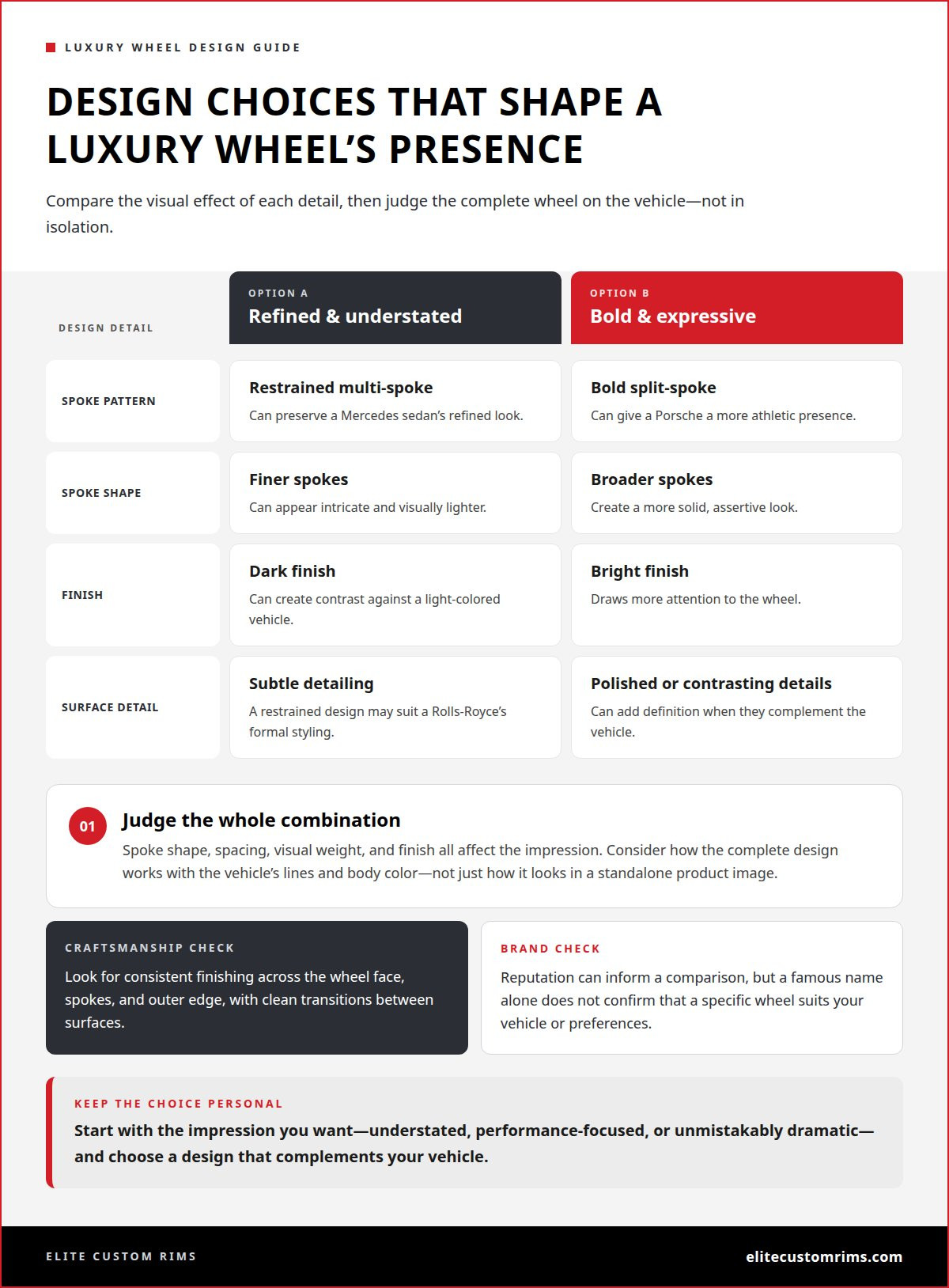
A wheel design should complement a vehicle’s lines, not compete with them. A restrained multi-spoke pattern can preserve a Mercedes sedan’s refined look, while a bold split-spoke design can give a Porsche a more athletic presence. Start with the impression you want: understated, performance-focused, or unmistakably dramatic.
Compare spoke shape, spacing, and visual weight. Broad spokes create a solid, assertive look, while finer spokes can appear intricate and lighter. A dark finish can create contrast against a light body, while a bright finish draws attention to the wheel. Judge the complete combination on the vehicle, not from a standalone product image.
Craftsmanship matters as much as styling. Look for consistent finishing across the face, spokes, and outer edge, along with clean transitions between surfaces. Polished details or contrasting finishes can add definition, but they should suit the vehicle. A subtle design, for example, may complement a Rolls-Royce better than a busy pattern that overwhelms its formal styling.
Brand reputation is another useful comparison point. Consider whether the manufacturer is known for the design approach and quality you want, then assess the product documentation and finish details. A famous name alone doesn’t establish that a specific wheel suits your vehicle or preferences. Evaluate the design and its documented specifications.
How much do factory luxury wheel upgrades cost by vehicle brand? There’s no single price across Mercedes, Porsche, Tesla, or other brands. The cost depends on the vehicle, trim, wheel design, and whether the upgrade is part of a larger factory package.
In the United States, ideas about automotive status vary among drivers and social circles. Some admire exclusive new cars, while others value classic muscle or a carefully maintained older vehicle. Choose a design that expresses your taste. A wheel that feels right on a BMW may make a different statement on a Tesla, even if both attract attention.
3. Forged materials and wheel durability
Forging describes how a wheel’s metal is shaped, not a promise that it can withstand every impact. A forged aluminum wheel is formed under pressure, then machined into its final design. Casting uses a different manufacturing process. The process matters, but material quality, engineering, and construction also affect performance.
Consider the vehicle and how you use it together. A Porsche driven on uneven roads faces different demands from a Mercedes used mainly for commuting. In either case, the wheel’s load capacity must suit the vehicle, and fitment must provide proper clearance. A forged label can’t make up for a wheel that doesn’t suit the application.
Look beyond the word “forged” when comparing options. Review the manufacturer’s documentation for material, construction, load information, and care guidance. Examine the finish closely: scratches, chips, and corrosion can affect appearance and expose the surface to further wear. A polished design on a daily-driven Audi, for example, needs regular cleaning and prompt attention to visible damage.
Durability also depends on road conditions and maintenance. Potholes and hard impacts can damage wheels regardless of construction, while brake dust and road grime can degrade the finish. Maintain the tires, clean the wheels with products suited to their finish, and inspect for bends, cracks, or air loss after a significant impact. Have a damaged wheel professionally assessed before continuing to use it.
Choose forged construction for its actual qualities, not as a shortcut around fitment or care. Compare the complete wheel, including its design, documented specifications, and finish. For a Tesla or Land Rover, the best decision balances the desired appearance with vehicle requirements and the roads you regularly travel. Construction is one part of durability; correct selection and attentive upkeep complete the picture.
4. How much do premium aftermarket wheels for high-end vehicles cost?
Premium aftermarket wheel prices depend on the specific wheel and vehicle, so there’s no reliable figure that applies to every Porsche, Audi, or Mercedes. A set’s total reflects factors such as construction, design complexity, finish, size, and brand. Compare like with like: a basic design and a detailed, multi-finish wheel aren’t equivalent choices.
Construction affects price comparisons. Forged wheels use a different manufacturing process from cast wheels, and that difference can affect product cost. Still, “forged” alone doesn’t tell you whether a particular wheel offers the right value. Assess its documented specifications, design, and suitability for your vehicle together.
Finish and styling can also affect the total. A straightforward finish differs from a design with contrasting surfaces or intricate spoke details. Vehicle fitment matters, too: a wheel intended for a Tesla Model S may have different specifications from one suited to a Land Rover. Compare the exact model and trim, not just the vehicle badge.
Build a useful comparison by reviewing the full set of four wheels and checking what the listed price includes. Separate wheel pricing from related items such as tires, installation, or other parts, which aren’t necessarily included. Then compare products with similar construction, finish, and fitment. This helps reveal whether a lower price reflects a simpler design or different specifications.
For a value-focused decision, rank your priorities before choosing: appearance, construction, brand, or fitment. Avoid paying a premium for styling that doesn’t suit your vehicle or use. A well-matched wheel is a more meaningful upgrade than a high price alone. Explore wheel options for luxury vehicles and compare the designs available for your make.
Elite Custom Rims
Elite Custom Rims offers a practical next step when you’re ready to match wheel style with your vehicle. Its selection includes wheels for Audi, Chevy, Mercedes, and Porsche, with fitment options for these vehicles. Use this guide’s criteria to narrow your priorities, then explore designs for your make and model.
Turn to Elite Custom Rims when you want to compare luxury wheel options without judging appearance alone. Consider how each design complements your vehicle, then weigh it against the fitment requirements and construction details discussed above. A distinctive look works best when it also makes sense for your car.
For help exploring wheel options for your vehicle, contact Elite Custom Rims.
Choose a Look That Feels Like Yours
Make the final choice with your vehicle and personal style in mind. The right wheel isn’t simply the most striking option in a catalog; it should express your taste and complement the character you value in your car. Before deciding, identify the design detail you want to notice, then consider whether it will still feel right beyond a passing trend.
That balance makes status symbol wheels for high-end vehicles a personal choice, not a formula. Think about the impression you want to create and how your chosen style will complement your vehicle. Clear priorities make the final selection feel intentional.
Explore Audi Wheels, Chevy/GMC Wheels, and Mercedes Wheels as you narrow your options. Contact Elite Custom Rims today to explore a wheel style that feels right for your vehicle. Make your next choice with confidence.
Frequently Asked Questions
Which is the Best Luxury Car Wheels Company in the World?
There isn’t one universally best luxury wheel company; the right choice depends on your vehicle and priorities. Compare design quality, product documentation, compatibility information, and the support available with your purchase. A driver choosing wheels for a Porsche, for example, may value a different design character than someone selecting wheels for a Rolls-Royce. Judge the specific wheel and its suitability, not reputation alone.
What luxury and high-end vehicle wheel brands are considered status symbols?
Rolls-Royce, Bentley, Mercedes, and Jaguar are often associated with luxury status, while high-end BMW models and Tesla vehicles can signal exclusivity in the United States. What that means depends on the audience and social circle. Some people admire a new premium vehicle; others value a distinctive classic or an older car kept in excellent condition. Status isn’t defined by one universal badge.
Which wheel designs and finishes are most popular on luxury cars and SUVs?
There isn’t a single design that suits every luxury car or SUV. Mesh patterns, directional spoke layouts, and clean monoblock faces each create a different visual effect. A large SUV can carry a more assertive design, while a streamlined sedan may suit a simpler face. Consider how the wheel’s details relate to the vehicle’s body shape and the look you want.
How do forged, flow-formed, and cast wheels compare for luxury vehicles?
These terms describe different manufacturing methods. Forging shapes metal under pressure; casting pours molten metal into a mold. Flow forming starts with a cast wheel blank, then uses rollers to shape and compress its barrel. Each method offers a different balance of design possibilities and construction characteristics. Compare the specific wheel’s documented materials and specifications, since the process name alone doesn’t establish its suitability for your vehicle.