
Are replica wheels ever a safe option? Yes, if their materials, manufacturing, testing, and fitment support the vehicle’s requirements. The label alone says nothing about safety. Poorly made or incorrectly fitted wheels can crack, bend, or put added strain on vehicle components.
It’s reasonable to favor OEM wheels: they’re designed with a vehicle’s suspension, brakes, and weight distribution in mind. But the real comparison isn’t simply original versus replica. Look at the evidence for the wheel’s construction, testing, load rating, and compatibility.
This guide explains what replica wheels are and how casting, flow-forming, and forging affect their construction. You’ll learn how to assess standards, load capacity, bolt pattern, and offset; spot visible damage; and compare replicas with OEM options. The goal is to make a clear decision based on safety-critical details, not appearance alone.
Key Takeaways
- Learn what separates a true replica wheel from an OEM wheel, and why the label alone doesn’t determine safety.
- Understand how cast, flow-formed, and forged construction can affect a wheel’s strength and weight.
- Know which warning signs matter during a wheel inspection, and when a damaged wheel should be taken out of service.
- Compare wheels by their testing, load capacity, and vehicle-specific fitment, not appearance alone.
What is a replica wheel?
A replica wheel is a third-party wheel designed to reproduce an OEM wheel’s appearance. Its safety depends on its construction, testing, load rating, and fitment for the vehicle.
Material and Manufacturing Risks
Material and manufacturing risks arise when a wheel’s alloy or production process can’t withstand the stresses of driving. Wheel strength can vary with manufacturing methods, so buyers should consider how a wheel is made when assessing its suitability. The International Organization for Standardization identifies ISO 9001 certification as something to look for when assessing a wheel factory’s quality management. JWL, VIA, and TUV markings can also indicate testing or approval, but each relates to its own standard or application.
Structural Strength and Failure
Structural strength is a wheel’s ability to carry vehicle loads and handle impacts without cracking or deforming. Inferior materials, poor manufacturing, or an inadequate load rating can lead to cracks, fractures, bending, or sudden failure. A pothole or curb impact can expose weaknesses that aren’t visible at first glance. Untested wheels provide less evidence of how they perform under stress, so appearance alone can’t establish their strength.
In the United States, using replica wheels isn’t itself illegal, but warranty and insurance consequences can arise if a wheel contributes to a failure or crash. Under the Magnuson-Moss Warranty Act, a dealership can’t deny a warranty claim unless it proves the aftermarket part directly caused the failure. An insurer may deny a crash claim if replica wheels contributed to the accident or compromised safety. The wheel’s role in an incident matters; the replica label alone doesn’t establish liability.
For potholes, impact resistance matters: a poorly made replica may be more vulnerable to damage. Track use and heavy vehicles make testing, construction, and load rating especially important. Appearance doesn’t show whether a wheel can handle those demands.
Fitment is another safety factor. A replica may differ from the OEM wheel in bolt pattern, size, or offset, resulting in an improper fit. Match those specifications and the wheel’s load rating to the vehicle instead of assuming a similar design is an engineered equivalent.
Does Cast, Flow-Formed, or Forged Change the Answer?
Manufacturing method affects a wheel’s structure and weight, but the process name alone doesn’t establish safety. When choosing a wheel, consider construction alongside testing, load capacity, fitment, and the manufacturer’s quality controls.
Gravity casting pours molten metal into a mold. It can produce complex designs, but a cast wheel’s strength depends on its materials and manufacturing quality. Flow-forming starts with a cast wheel, then rollers apply pressure to shape and strengthen the barrel. Flow-formed replica wheels are typically 15-25% lighter than cast wheels of the same size. Lower weight can reduce rotational mass, but it doesn’t replace evidence of fatigue testing or an appropriate load rating.
Forging presses metal under thousands of tons of pressure. True forged wheels typically use 6061-T6 aluminum, and the process can create a strong, lightweight structure. A forged 19x10 wheel weighing well over 30 pounds would not support its forged-wheel claim. Treat construction claims as one part of the assessment, not a substitute for documented testing and vehicle-specific fitment.
“Replica” and “counterfeit” aren’t interchangeable. A replica is a third-party wheel designed to resemble an original OEM design. A counterfeit is presented as an original or uses branding that misrepresents its source. Reputable manufacturers use quality-control measures, materials, and production processes intended to meet or exceed safety requirements. A familiar appearance or logo alone doesn’t prove who made the wheel or how it was tested.
OEM wheels are engineered around a vehicle’s suspension, brakes, and weight distribution. Replicas may offer a different design, and savings depend on the product and purchase. Compare construction, load rating, and fitment before weighing the price difference. A warranty describes coverage for specified issues; it doesn’t prove fatigue strength or safe compatibility. Choose documented performance over a process label or low price alone.
Inspecting wheels for cracks and runout
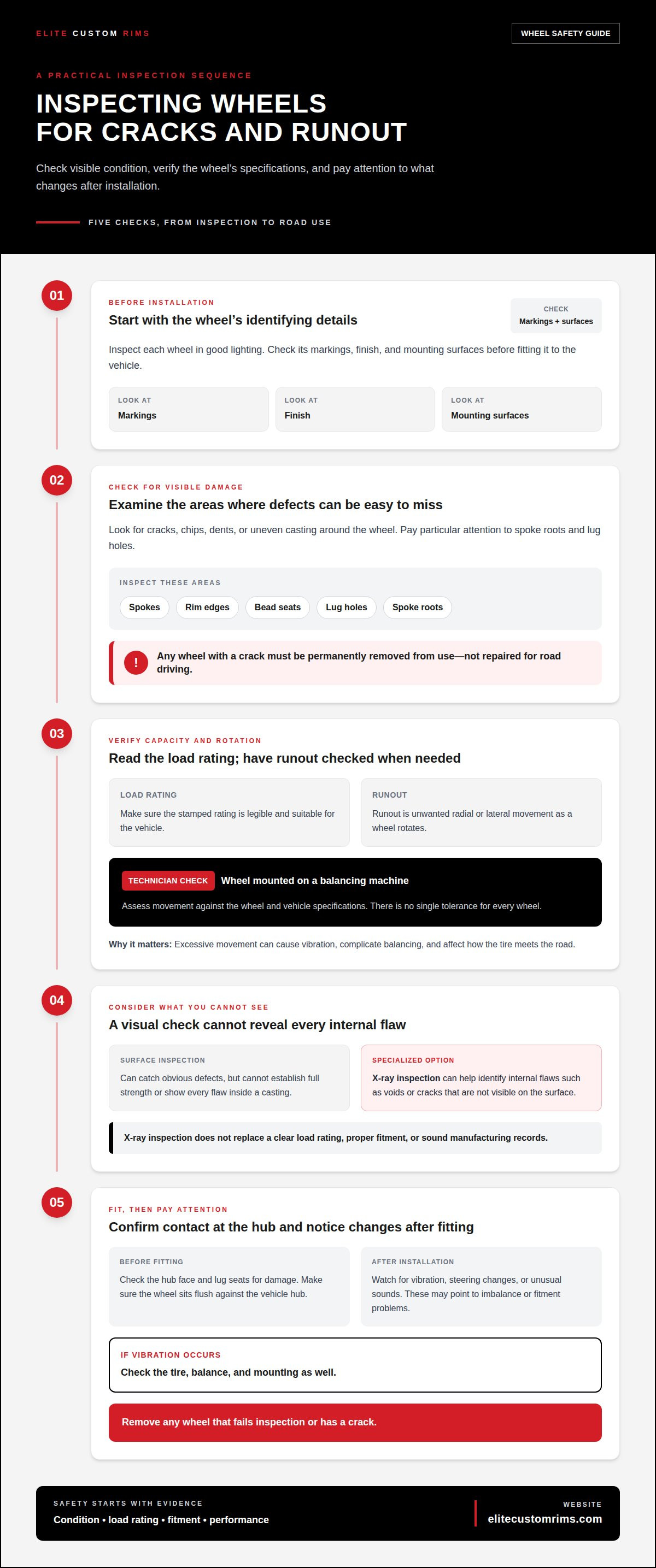
Before installation, inspect each wheel in good lighting, checking its markings, finish, and mounting surfaces. A visual check can catch obvious defects, but it can’t establish the wheel’s full strength or reveal every internal flaw.
Examine the spokes, rim edges, bead seats, and lug holes for cracks, chips, dents, or uneven casting. Pay close attention to spoke roots and lug holes, where damage can be easy to overlook. Check that the stamped load rating is legible and suitable for the vehicle. Reject any wheel with a crack. It must be permanently removed from use, not repaired for road driving.
Runout is unwanted radial or lateral movement as a wheel rotates. A technician can mount the wheel on a balancing machine and check whether the rim moves out of true. Excessive movement can cause vibration, complicate balancing, and affect how the tire meets the road. There’s no single tolerance for every wheel, so assess the measurement against the wheel and vehicle specifications. If vibration occurs after installation, check the tire, balance, and mounting as well.
Visual inspection won’t reveal every defect inside a casting. X-ray inspection can help identify internal flaws, such as voids or cracks, that aren’t visible on the surface. It’s a specialized test, not a substitute for a clear load rating, proper fitment, or sound manufacturing records. If you suspect a hidden defect, don’t rely on appearance alone.
Check the hub face and lug seats for damage before fitting, then make sure the wheel sits flush against the vehicle hub. After installation, watch for vibration, steering changes, or unusual sounds. These may point to imbalance or fitment problems that can affect suspension components. Remove any wheel that fails inspection or has a crack. Don’t use pressure, refinishing, or balancing to disguise structural damage.
Replica and OEM wheel comparisons
A useful comparison goes beyond appearance. OEM wheels are designed for a specific vehicle, while aftermarket replicas vary by manufacturer, construction, and application. Some quality replicas closely reproduce an original wheel’s look and structure, but resemblance alone doesn’t demonstrate equivalent testing or performance.
OEM wheels undergo stress, impact, and fatigue testing. A replica’s value depends on evidence about its own design and production, not simply on tests performed on an original. These figures aren’t universal pass marks. The wheel’s load rating must suit the vehicle’s requirements.
Compare the specifications that determine whether the wheel fits and supports the vehicle:
- Load rating: Match the wheel’s stated capacity to the vehicle’s weight demands.
- Bolt pattern and offset: Confirm they suit the vehicle, not just the wheel’s appearance.
- Hub bore and lug seats: Check that the wheel centers correctly and accepts the vehicle’s hardware.
- Brake clearance: Confirm the wheel clears the installed brakes, especially with an aftermarket big brake kit.
- Construction and testing: Look for documented methods and application-specific test evidence.
Weight also matters. A heavier replica can increase rotational inertia and affect acceleration, braking, fuel efficiency, and handling. A forged or flow-formed label doesn’t settle the comparison; the wheel’s actual specifications and testing still matter. For example, a wheel with the correct bolt pattern but an insufficient load rating isn’t the right choice.
OEM wheels may help retain resale value, while a well-made replica can offer a different appearance. Decide by weighing verified fitment, load capacity, construction, and testing against the value of keeping original equipment. Compare vehicle-specific wheel options with those criteria in mind.
Elite Custom Rims
Elite Custom Rims offers wheels for Audi, Chevy/GMC, Mercedes, and Porsche vehicles. If you’re comparing replica and OEM options, use this guide’s safety criteria to focus on fitment, load rating, construction, and testing. These checks help distinguish a familiar-looking design from a wheel suited to your vehicle’s requirements.
Explore the wheel options for your vehicle and compare their specifications with its requirements. Elite Custom Rims can help you narrow replacement or appearance-change options by vehicle brand. Start with compatibility and capacity, not styling alone.
Contact Elite Custom Rims to discuss wheel options for your vehicle.
Make your next wheel decision with confidence
Whether replica wheels are ever a safe option depends on the specific wheel and how well it suits your vehicle. Before choosing, decide what matters most for your setup: preserving the original look, changing the style, or accommodating a modified vehicle. Those priorities can narrow your options and keep appearance from overshadowing practical requirements.
Take the next step with the vehicle’s make, model, and intended use in mind. A focused conversation can help you explore suitable wheel options and understand which details deserve attention as you choose. If you’re ready to discuss your choices, contact Elite Custom Rims. Make a considered choice, and move forward with confidence.
Frequently Asked Questions
Do JWL, VIA, and TUV marks mean the wheel was actually tested?
A mark alone doesn’t settle whether replica wheels are ever a safe option; it identifies a standard or verification that needs context. JWL is a Japanese government standard for wheels sold in Japan, while VIA provides third-party verification of a JWL claim registered there. TUV is German third-party approval tied to specific vehicle applications. Look for documentation connecting the mark to the specific wheel and application.
How do you check a wheel load rating?
Read the wheel’s stamped load rating and compare it with the vehicle’s higher Gross Axle Weight Rating (GAWR). Under the guideline used here, each wheel should carry at least half that higher axle rating. For example, a vehicle with a 2,600-pound GAWR needs wheels rated for at least 1,300 pounds each. A rating below the threshold makes the wheel unsuitable for that vehicle.
How do you spot a fake forged wheel?
Start with the manufacturer’s records for the specific wheel, including its stated construction and specifications. Weight can raise a question: a forged 19x10 wheel weighing well over 30 pounds doesn’t support a forged-wheel claim. That figure alone doesn’t identify a counterfeit, so compare the claim with the wheel’s documentation and manufacturing details before accepting the label.
What should you do if you already own replicas?
Check the wheel markings, load rating, and vehicle fitment, then inspect the spokes, rim edges, and lug holes for damage. Don’t drive on a wheel with a crack; remove it permanently from use. After installation, recheck lug-nut torque after the first 50 to 100 miles. Vibration or steering changes also call for prompt inspection of the wheel, tire, and balance.
Are replica wheels safe compared with OEM wheels?
Whether replica wheels are ever a safe option depends on the specific wheel’s construction, testing, load capacity, and fitment. OEM wheels are designed for the vehicle’s suspension, brakes, and weight distribution, and undergo stress, impact, and fatigue testing. Compare evidence for a replica against the vehicle’s requirements; a matching appearance doesn’t establish equivalent performance.
What safety standards and certifications apply to replica wheels in the United States?
Modern cast replica wheels meet federal wheel safety regulations for street use. JWL is a Japanese standard, VIA provides third-party verification of a JWL claim registered in Japan, and TUV approval is German and tied to specific vehicle applications. ISO 9001, according to the International Organization for Standardization, concerns a factory’s quality management; it isn’t a wheel-specific safety test.