
Bigger wheels can mean less EV range, while lighter wheels can help recover approximately 2 to 4% through mass reduction alone. The impact of wheel weight on EV range anxiety is real, but it’s only part of the picture: wheel diameter, tire width, and rolling resistance also affect efficiency. The right setup balances range with the look and feel you want.
When every mile matters, it makes sense to consider wheel weight. But a lightweight wheel isn’t automatically the most efficient choice: the complete wheel-and-tire setup can also affect aerodynamic drag and rolling resistance.
This guide explains how wheel size and weight influence energy use, why cast and forged construction differ, and how those trade-offs can affect real-world range. It also shows how to assess range concerns without treating any single wheel specification as the whole answer.
Key Takeaways
- Compare the complete wheel-and-tire setup, not diameter alone, to understand how your choice may influence EV efficiency and comfort.
- Learn why wheel mass matters during acceleration and how cast and forged construction can affect weight.
- Put range estimates in context: tire width, rolling resistance, pressure, and driving speed can also shape energy use.
- Use the article’s comparison points to weigh efficiency against appearance and performance when choosing wheels for your EV.
Battery range improvements
Battery capacity is only one part of EV range; wheels, tires, and aerodynamics shape energy use. Some new-generation EVs approach 500 miles or more, but wheel choices still influence efficiency.
Efficiency Gains from Lower Wheel Weight
Unsprung wheel weight is mass that the suspension doesn’t support, including wheels and tires. Reducing it can improve efficiency and acceleration response because the motor has less rotating mass to turn. The relationship between torque, inertia, and angular acceleration is expressed as τ = Iα. In practical terms, lowering wheel mass can help the vehicle respond more readily when accelerating.
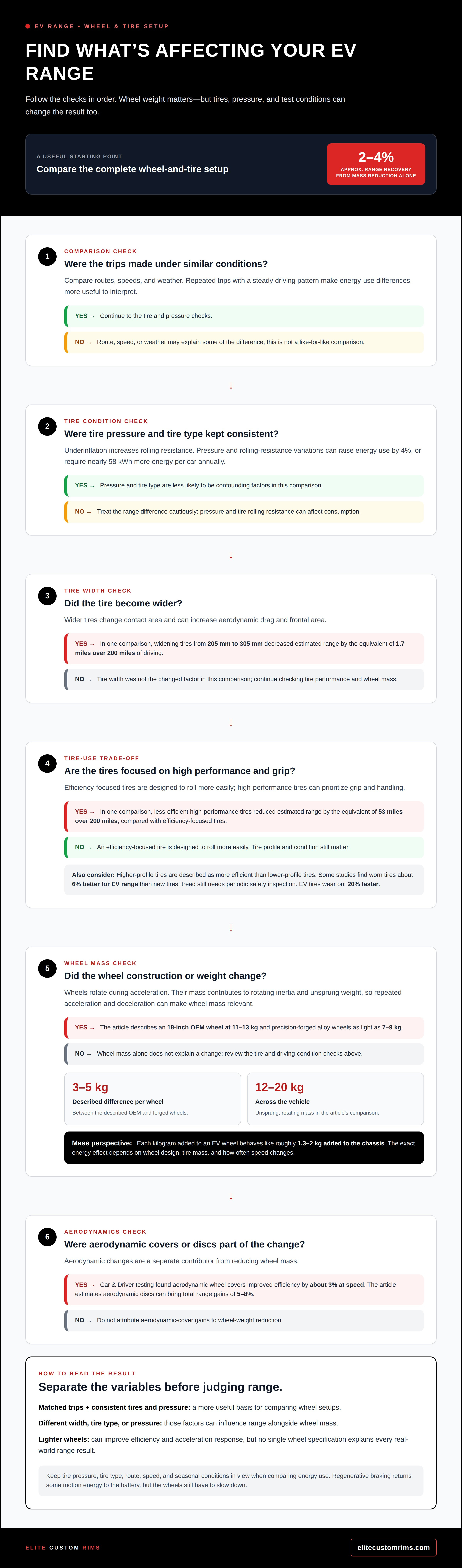
Wheel construction affects that mass. An 18-inch OEM wheel is described at 11 to 13 kilograms, while precision-forged alloy wheels can weigh as little as 7 to 9 kilograms. A lighter wheel can therefore reduce rotating weight, though the vehicle’s total response also reflects tire mass and driving conditions.
Estimating Range Benefits
To estimate the effect on range, compare energy use before and after a wheel change under similar driving conditions. Record the vehicle’s usual consumption, then compare it with results using the lighter setup on similar routes, at similar speeds, and in similar weather. This is more useful than assuming every lighter wheel delivers the same gain.
To judge whether lighter wheels might ease range anxiety, compare how far the vehicle travels using its available battery energy. Keep tire pressure and tire type consistent, since underinflation and rolling resistance can also affect consumption. A change in wheel mass alone cannot explain every difference in range.
Aerodynamics offer another range-improvement route. Car & Driver testing found aerodynamic wheel covers improved efficiency by about 3% at speed. The page estimates aerodynamic discs can bring total range gains of 5 to 8%. These figures describe aerodynamic changes, not the benefit of reducing wheel weight, so treat them as separate contributors.
For a practical comparison, keep the route and driving pattern steady, then track energy use across repeated trips. Record tire pressure and seasonal conditions, too. EV-specific winter tires balance cold-weather grip with low-rolling-resistance construction, which can help reduce the range penalty of standard winter tires.
EV range concerns
Wheel choice affects range, but tire characteristics can make the difference more noticeable. Tire width changes the contact area and can increase aerodynamic drag. In one comparison, widening tires from 205 millimeters to 305 millimeters decreased estimated range by the equivalent of 1.7 miles over 200 miles of driving. That example isolates a tire-width change, not every factor affecting an EV’s real-world range.
Wider tires can increase frontal area, so the vehicle may push more air as it moves. Tire pressure matters too: underinflation increases rolling resistance, requiring more energy to keep the car moving. Variations in tire pressure and rolling resistance could raise an electric car’s energy use by 4%, or require nearly 58 kilowatt-hours more energy per car annually. These figures show why a wheel comparison should include the tires and their condition.
Rolling resistance helps explain another trade-off. Efficiency-focused tires are designed to roll more easily, while high-performance tires can prioritize grip and handling. In one comparison, less-efficient high-performance tires reduced estimated range by the equivalent of 53 miles over 200 miles, compared with efficiency-focused tires. The impact of wheel weight on EV range anxiety is easier to evaluate when tire performance is considered separately.
Profile also matters. Higher-profile tires are described as more efficient than lower-profile tires, while offering more sidewall between the wheel and road. Tire wear complicates comparisons: some studies find worn tires about 6% better for EV range than new tires. A range decrease just after installing new tires is normal, but drivers should periodically inspect tread for safety. Electric vehicle tires also wear out 20% faster, making tread condition relevant to range and maintenance decisions.
To assess the impact of wheel weight on EV range anxiety, compare energy use on similar routes and keep tire pressure consistent. Consider tire width, profile, rolling resistance, and condition together. A single mileage estimate cannot account for every combination of speed, road, and driving style.
How does wheel weight affect electric vehicle energy consumption and driving range?
Wheel weight affects energy use because each wheel must rotate whenever an EV accelerates. Rotational inertia follows I = mr2: mass and distance from the center both influence how much effort rotation requires. A heavier wheel can therefore demand more energy to spin, especially during repeated acceleration and deceleration in city driving.
Wheel mass also counts as unsprung weight, which moves with the wheel rather than being supported by the suspension. Each kilogram added to an EV wheel behaves like roughly 1.3 to 2 kilograms added to the chassis. The effect matters beyond the scale: extra unsprung mass can make suspension control more demanding over uneven pavement, while lighter wheels can support a more responsive feel.
The construction comparison gives the weight difference practical context. Described OEM and forged wheels differ by 3 to 5 kilograms per wheel. Across the vehicle, that becomes 12 to 20 kilograms of unsprung, rotating mass. The exact effect on energy consumption depends on wheel design, tire mass, and how often the vehicle changes speed.
Regenerative braking returns some motion energy to the battery, but the wheels still have to slow down. Rotating components can account for up to 13 percent of energy flow during regenerative braking events. Reducing wheel mass changes the energy involved in acceleration and braking; it doesn’t mean all energy used to turn the wheels is lost.
Wheel size matters as well as weight. Bigger wheels and wider tires can reduce EV efficiency and range, while smaller wheels and narrower tires can improve efficiency and comfort. A lighter wheel may offer less benefit if a larger diameter or wider tire increases other energy demands. Compare the complete wheel-and-tire setup, not wheel weight alone.
For drivers concerned about range, the useful question is how the complete setup affects consumption during typical driving. City routes with frequent changes in speed make rotational mass more relevant, while steady-speed driving places different demands on the vehicle. Wheel weight is one factor, not a standalone predictor of range.
How much range can heavier wheels reduce on an EV, in percentage or miles?
Lightweight wheels can recover approximately 2 to 4% of EV driving range through mass reduction alone. That estimate offers a useful scale, not a promise for every vehicle. The actual effect depends on the wheel-and-tire combination, route, speed, and driving pattern. Treat the percentage as one way to frame a potential benefit, then weigh it against the complete setup.
A Tesla Model 3 Performance comparison gives a more specific example. At a constant 75 mph, its estimated range was about 40 miles lower with 20-inch wheels than with 18-inch wheels. This result compares wheel sizes, so it doesn’t isolate wheel weight as the only cause. Diameter, tire selection, and aerodynamic effects can contribute to the difference.
That distinction matters when translating a test result to everyday driving. A highway estimate at 75 mph won’t directly predict range on a route with frequent stops, changing speeds, or different road conditions. Likewise, a percentage estimate from mass reduction alone isn’t equivalent to a wheel-size comparison. Keep each figure tied to the conditions and change it describes.
For a practical evaluation, compare the current setup with the proposed one. Separate changes in wheel mass from changes in diameter and tire specifications, then compare energy use on similar routes and in similar conditions. This cannot turn a published estimate into an exact personal result, but it can show whether wheel choice is a meaningful part of the range concern.
Range anxiety often centers on the distance available for a particular trip. Use the 2 to 4% estimate as broad context, and the Tesla Model 3 Performance example as a separate size comparison. Neither figure should be applied as a guaranteed range change to another EV. The most useful decision accounts for vehicle, complete wheel-and-tire setup, and typical driving needs.
An EV’s greater weight also makes the braking advantage of winter tires proportionally more significant. That is a separate factor to consider when choosing a wheel-and-tire setup.
Elite Custom Rims
Elite Custom Rims offers wheel options for drivers considering appearance, fitment, and range. If you’re choosing wheels for an EV, use the comparisons above to identify what matters most for your driving. Then choose a setup suited to your vehicle rather than assuming every larger or lighter design affects range in the same way.
Explore wheel options for Audi, Chevy/GMC, Mercedes, and Porsche vehicles. The right choice depends on your vehicle and whether you prioritize a particular look, fitment, or a balance of style and efficiency.
For help with wheel options for your vehicle, contact Elite Custom Rims.
Choose a wheel setup that fits your priorities
The impact of wheel weight on EV range anxiety is best assessed alongside your driving needs and the complete wheel-and-tire setup. Range matters, but so do the appearance and driving character you want. Let those priorities guide your choice instead of treating one specification as the whole answer.
Elite Custom Rims offers wheel options for Audi, Chevy/GMC, and Mercedes vehicles. Share your vehicle details and goals with a specialist to get fitment confirmed and clarify your next step, whether efficiency or a particular style leads your decision.
Explore wheel options with Elite Custom Rims and move forward with a setup that suits your vehicle and priorities.
Frequently Asked Questions
Does wheel size affect EV range?
Yes, changing wheel size can affect an EV’s range, especially when the change also alters tire dimensions. For a useful comparison, keep the vehicle and driving conditions consistent and assess the complete setup, not diameter alone. A larger wheel paired with a wider tire, for example, can have different efficiency trade-offs from a larger wheel paired with a narrower tire.
Electric vehicle range: what’s tires got to do with it?
Tires affect how much energy an EV uses to move, turn, and maintain grip. Rolling resistance, width, pressure, and construction all play a part. An efficiency-focused tire may roll more easily, while a high-performance tire may prioritize grip. The practical choice depends on driving conditions and the balance you want between efficiency and handling.
How do wheel size, tire width, and aerodynamic design compare with wheel weight in affecting EV range?
These factors affect range through different mechanisms, so no single one always dominates. Wheel weight changes the effort needed to accelerate rotating mass; tire width can influence drag and rolling resistance; and wheel design shapes airflow. At higher vehicle speeds, aerodynamic resistance rises with the square of velocity, making airflow an important consideration for highway driving.